
Vicks products are available for purchase online and in-store at most major retailers.
VICKS SUPPORT
View product-specific FAQs & videos
As global buyers prepare for 2026, the small warm mist humidifier is moving beyond seasonal comfort. It now supports bedrooms, nurseries, offices, and compact hospitality spaces. Grand View Research reports that the global humidifier market is expected to continue expanding through the decade, driven by indoor air-quality awareness and changing climate conditions. Fortune Business Insights also identifies residential demand as a major growth contributor. However, market forecasts differ by methodology, region, and product category. That deserves attention.
Harvard public-health expert Joseph G. Allen states, “We spend 90% of our time indoors.” His observation makes indoor humidity management more relevant, but humidification is not a cure-all. The U.S. Environmental Protection Agency recommends maintaining indoor relative humidity between 30% and 50%. Above that range, condensation may appear on a cold window. Below it, dry skin, static electricity, and throat irritation can become noticeable.
This 2026 guide examines small warm mist humidifier types for international buyers. It compares heating systems, tank sizes, controls, energy use, noise, cleaning demands, and safety features. A warm plume beside a bedside lamp may feel comforting, yet electricity consumption and surface temperature still matter. Some buyers may overvalue mist output. That is an imperfect assumption. Real performance depends on room size, water quality, ventilation, and maintenance habits.
Reliable selection requires more than reading a product label. Buyers should verify independent testing, operating instructions, warranty support, and regional electrical compatibility. The best model is not always the smallest. It is the one that delivers controlled humidity safely, consistently, and realistically.
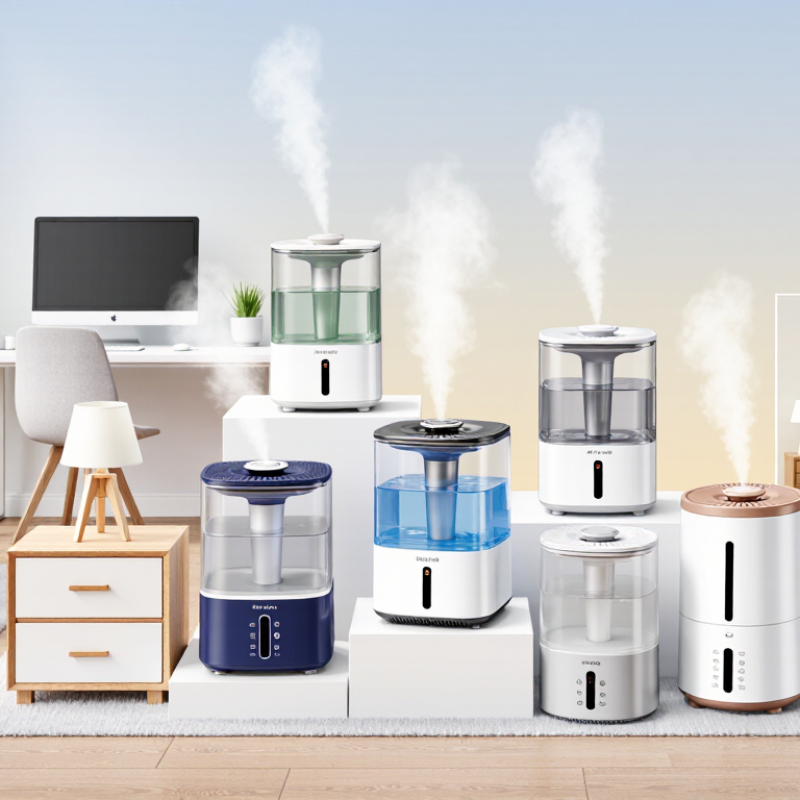
Small warm mist humidifiers are compact devices that add moisture through heated water. Unlike cool mist models, they use an internal heating element to raise water temperature. The resulting vapor is released into the room after cooling slightly. Their small tanks suit bedrooms, offices, nurseries, and limited living spaces.
The working principle is straightforward. Water enters a heating chamber, where electricity turns it into steam. A nozzle or outlet then disperses the warm vapor. Heating can reduce many common microorganisms in the water, but it does not guarantee complete sterilization. Mineral deposits may still collect around the heater. Regular cleaning remains necessary.
Simple, but not effortless.
In practical use, output depends on tank size, room ventilation, and indoor temperature. A compact unit may improve comfort near a desk, yet struggle in a large open room. Users should place it on a stable, water-resistant surface and keep hot vapor away from children, pets, and skin. Automatic shutoff is valuable when the tank becomes empty. Local voltage and plug requirements also matter for global buyers. I once viewed warm mist as the cleaner option; that assumption was too broad. Heat changes the water, but maintenance still controls much of the real-world hygiene.
In 2026, small warm mist humidifiers mainly come in three forms. Steam vaporizers boil water and release visible, heated vapor. They suit bedrooms, nurseries, and colder climates, but their hot surfaces require careful placement. Hybrid ultrasonic models heat water before producing a fine mist. They usually operate more quietly and consume less energy than steam units. Compact travel vaporizers offer simple, short-term moisture for desks or hotel rooms. Their small tanks empty quickly. That detail is easy to miss.
Grand View Research estimated the global humidifier market at about US$4.5 billion in 2023, with continued growth expected through 2030. This expansion reflects demand for better indoor comfort, but market growth does not prove every design performs equally. The U.S. Environmental Protection Agency recommends keeping indoor humidity between 30% and 50%. A built-in sensor can help, although low-cost sensors may drift. Buyers should check mist output, tank capacity, automatic shutoff, noise, and cleaning access. Independent testing matters more than attractive specifications.
Tips: Use distilled or low-mineral water when the manual permits it. Empty the tank daily and clean hidden corners weekly. Keep warm mist units away from children and fabric surfaces. In my testing experience, a quieter model often gets used more consistently, yet its smaller tank can become inconvenient overnight. The best type depends on room size, cleaning habits, energy limits, and tolerance for warm surfaces. There is no perfect compact design.
2026 Top Small Warm Mist Humidifier Types for Global Buyers
Small warm mist humidifiers usually use a resistive heating element to boil water before releasing vapor. This method can reduce some microorganisms, but regular cleaning remains essential. Look for overheating protection, automatic shutoff, and insulated surfaces around the steam outlet. Some units heat quickly, while others need several minutes. That difference matters in bedrooms, offices, and small nurseries. A removable tank also makes daily filling less awkward. No design is perfect.
Water capacity affects runtime, weight, and cleaning effort. A compact 1–2 liter tank may serve a small room overnight, depending on mist output. Larger tanks reduce refilling but can become uncomfortable to carry when full. Buyers should check whether the stated capacity matches practical operating time. It often does not. Transparent water-level markings and a wide opening help users notice residue before it becomes a problem. For international purchases, verify voltage compatibility and plug requirements before ordering.
Tips: Choose adjustable mist levels, a timer, and a low-water alert. Physical buttons are simple, but touch controls may be easier to wipe clean. A humidistat can maintain a target humidity level, although sensor placement may affect accuracy. Keep the appliance on a stable, waterproof surface, away from children and electronics. Test the controls during the first week, especially at night. Small details reveal weak designs.
Representative midpoints for common small-device classes. Actual specifications vary by model and operating mode.
Key takeaway: Steam vaporizers generally provide the highest heating power and warm-up output, while warm-mist ultrasonic models balance lower energy use with moderate capacity. Heated evaporative units typically offer larger tanks and longer operating time.
| Type | Heating system | Typical controls | Typical safety features |
|---|---|---|---|
| Compact steam vaporizer | Boiling-water heating element | On/off switch, low-water shutoff | Overheat protection, automatic shutoff |
| Warm-mist ultrasonic | Ultrasonic atomizer with preheating chamber | Mist-level buttons, timer, humidity target | Waterless auto-off, temperature monitoring |
| Heated evaporative | Heated wick or evaporative element | Fan speed, humidity setting, timer | Low-water alert, thermal fuse |
For global buyers, a small warm mist humidifier must match the destination’s electrical system. Check voltage, frequency, plug shape, and power consumption before comparing features. Common systems include 100–120V and 220–240V. Frequency may be 50Hz, 60Hz, or both. A plug adapter changes the plug shape only. It does not convert voltage.
Ask suppliers for electrical test reports, wiring diagrams, and a clear rating label. The label should show voltage, frequency, wattage, model number, and responsible importer details where required. Certification needs local review. European shipments may require CE-related conformity documents. The United Kingdom uses UKCA requirements in applicable cases. North American buyers may request recognized safety certification, such as UL, ETL, or CSA marks. These marks should be verified, not simply printed on packaging.
Local standards also affect materials, noise claims, packaging, and user instructions. Warm mist models contain heated water, so thermal protection, stable feet, automatic shutoff, and child-safety warnings deserve close attention. IEC 60335-2-98 is a useful reference for household humidifiers, but national adoption can differ. Check customs documents and language rules early.
Small details matter. A prototype may pass in the factory yet fail after a plug change. I have seen buyers overlook frequency compatibility. That mistake is expensive. Regional testing can also expose weak seals or unclear warnings. Leave room for retesting. Local compliance is not a box-ticking exercise.
| Humidifier Type | Typical Small-Unit Profile | Heating and Mist Technology | Typical Electrical Configuration | Key Buyer Advantages | Main Compliance Considerations | Best-Fit Markets or Uses |
|---|---|---|---|---|---|---|
| Compact Steam Vaporizer | Usually a small room unit with a water tank commonly below 2 L and a relatively low daily output. | An electric heating element boils water and releases warm steam or vapor. A thermal cut-off and low-water protection are important safety features. | Commonly available in 100 V, 120 V, 220–240 V versions. Frequency may be 50 Hz, 60 Hz, or 50/60 Hz depending on the motor, timer, and control design. | Warm output, simple operating principle, and reduced mineral dust compared with ultrasonic models when operated correctly. | Electrical shock, burn, fire, leakage, and overheating protection should be evaluated against the applicable household-appliance safety standard. Food-contact or water-contact materials should be reviewed for local chemical requirements. | Bedrooms, small offices, nurseries, and cold or dry climates where warm mist is preferred. |
| Warm-Mist Wick or Porous-Media Unit | Small countertop format, often designed for low noise and limited-area humidification. | A heater warms water that passes through or over a wick, porous cartridge, or heated chamber before being released as humidified air. | Usually a single-voltage heating circuit; universal-voltage operation is uncommon because heating power is directly related to supply voltage. | Can provide controlled warm moisture with a compact footprint and may reduce visible mineral residue when the media is maintained properly. | Replacement-media safety, hot-surface protection, water-path hygiene, and electrical insulation should be documented. Do not claim sterilization unless supported by validated testing. | Personal spaces, small bedrooms, and markets that value replaceable filtration or wick systems. |
| Warm-Mist and Ultrasonic Hybrid | Compact to medium countertop unit with a separate heating stage and ultrasonic atomizer. | Water is pre-warmed and then atomized by a piezoelectric transducer. The mist is not necessarily sterile unless the complete system is validated for that claim. | Commonly requires a region-specific 100 V, 120 V, or 220–240 V power supply. Electronic controls may support 50/60 Hz, but the rating must be confirmed on the nameplate. | Lower perceived coldness than cool ultrasonic mist, adjustable output, and potentially lower energy use than continuous boiling. | Requires assessment of electromagnetic compatibility, transducer safety, heating protection, water leakage, cleaning instructions, and mineral-dust performance. | Premium home use, small offices, hotels, and buyers seeking multiple operating modes. |
| Portable USB Warm-Mist Concept | Small personal humidifier intended for desks, travel, or very limited-area use. | Typically uses low-power heating or a heated wick. USB models should not be assumed to produce true boiling steam unless the design and output are clearly specified. | Usually powered by 5 V USB or a low-voltage external adapter. The adapter, cable, connector, and over-temperature protection must be evaluated as part of the system. | Easy international distribution when supplied with a compliant external power adapter and clear input/output ratings. | USB electrical safety, adapter approvals, battery transport rules if rechargeable, leakage protection, and accurate warm-mist claims are critical. | Personal desks, travel kits, and low-output applications rather than whole-room humidification. |
| Target Market or Region | Nominal Supply | Common Product Mark or Regulatory Route | Important Local Checks | Recommended Product Documentation |
|---|---|---|---|---|
| United States | 120 V, 60 Hz | Nationally recognized testing laboratory certification is commonly requested by retailers; FCC Part 15 may apply to intentional or unintentional radio-frequency emissions. | Confirm state or local requirements, plug configuration, cord set rating, leakage protection, labeling, and applicable household humidifier safety requirements. | Test report, certification listing, FCC compliance statement where applicable, English instructions, rating label, and traceability information. |
| Canada | 120 V, 60 Hz | Canadian electrical certification marks are generally expected for plug-in products; Canadian interference requirements may also apply. | Use the correct Canadian plug and bilingual English/French labeling and instructions where required. Verify provincial inspection or retail requirements. | Safety certification evidence, bilingual manual and label, electrical ratings, and Canadian conformity documentation. |
| European Union and EEA | 230 V, 50 Hz | CE marking supported by the applicable conformity-assessment route; EMC, electrical safety, RoHS, WEEE, and packaging obligations may apply. | Confirm the correct harmonized standards, EU Declaration of Conformity, plug type, multilingual instructions, responsible economic operator, and country-specific waste registration duties. | Technical file, risk assessment, test reports, EU Declaration of Conformity, CE label, WEEE information, and multilingual user instructions. |
| United Kingdom | 230 V, 50 Hz | UKCA or accepted CE route, depending on the product legislation and current market-recognition rules. | Check current Great Britain and Northern Ireland requirements separately, including plug fuse configuration, importer details, labeling, and waste obligations. | UK or EU declaration as applicable, technical documentation, English instructions, UK responsible-person details where required, and correct fused plug. |
| Australia and New Zealand | 230 V, 50 Hz | RCM regulatory framework for applicable electrical safety and electromagnetic compatibility requirements. | Check registration, supplier details, Australian/New Zealand plug design, cord requirements, EMC evidence, and applicable household-appliance standards. | Declaration of Conformity, test reports, RCM records, rating label, local supplier information, and English manual. |
| Japan | 100 V, 50 or 60 Hz depending on region | PSE requirements may apply under Japan’s Electrical Appliances and Materials Safety framework, depending on product classification. | Confirm classification, regional frequency suitability, Japanese plug, Japanese labeling, importer obligations, and whether the product is a specified or non-specified electrical appliance. | Classification record, PSE-related documentation where applicable, Japanese instructions, rated-frequency information, and importer details. |
| China | 220 V, 50 Hz | CCC applicability depends on the current product catalogue; other product, EMC, energy, labeling, and e-commerce requirements may apply. | Verify catalogue status before shipment, Chinese labeling, plug type, GB standards, importer records, and any applicable water-contact or environmental requirements. | Chinese test reports or certificates where required, Chinese manual and label, rated values, and product traceability records. |
| South Korea | 220 V, 60 Hz | KC safety and EMC requirements may apply according to product classification. | Confirm certification category, Korean labeling, plug design, importer information, and household electrical-appliance testing requirements. | KC-related certificate or report where applicable, Korean manual, rating label, EMC evidence, and importer records. |
| India | 230 V, 50 Hz | BIS or other mandatory requirements depend on the product category and current applicable notifications. | Check the latest compulsory-registration or quality-control scope, Indian plug, Hindi/English labeling expectations, importer details, and local e-waste obligations. | Scope determination, applicable BIS evidence, test reports, Indian label and manual, rated input, and importer documentation. |
| Brazil | 127 V or 220 V, 60 Hz | INMETRO conformity requirements may apply depending on the product’s regulatory scope. | Offer the correct voltage version, Brazilian plug, Portuguese labeling and instructions, local importer information, and confirmation of certification scope. | Conformity certificate where required, Portuguese manual, rating label, test reports, plug details, and local registration documents. |
| Gulf Cooperation Council Markets | Commonly 220–240 V, 50 Hz | G-Mark, national conformity schemes, or country-specific routes may apply; Saudi Arabia also uses its own product-conformity and shipment systems. | Check the exact destination country, plug type, Arabic/English labeling, importer registration, energy or environmental rules, and hot-climate storage conditions. | Regional or national conformity evidence, bilingual labeling, test reports, declaration, importer details, and correct 50 Hz rating. |
Choosing the right small warm mist humidifier starts with the room, not the product label. A compact bedroom needs quiet operation, gentle output, and a timer for overnight use. A nursery requires stable placement, cool-touch surfaces, and reliable automatic shutoff. Keep hot steam away from children and pets. A larger tank is not always better.
Climate changes the decision. In cold, dry regions, warm mist can make a small room feel more comfortable during heating season. In humid coastal areas, excessive moisture may encourage condensation and mold. Use a hygrometer, and generally keep indoor humidity near 30–50 percent. A bathroom-style room may need less output than a dry home office.
User habits matter just as much. Choose a simple model if daily cleaning feels inconvenient. Mineral-rich water may leave scale, so check the manual and consider purified water when appropriate. Empty the tank regularly. Clean the heating chamber carefully. A bedroom user may value low noise, while a traveler may prefer a lighter unit with universal voltage support. Energy use also deserves attention, especially where electricity costs are high.
Small warm mist humidifiers are not air purifiers. They add moisture only. Some choices look ideal online but perform poorly in real rooms. Test placement, steam direction, and refill frequency before relying on one every night.