







How to Choose an Outdoor LED Display Manufacturer?
Choosing an outdoor LED display manufacturer is not a simple price comparison. It is a decision about brightness, weather resistance, service, and long-term risk. A brilliant screen can still fail if its cabinet seals weaken after heavy rain or its cooling system struggles under direct sunlight.
As LED display specialist Bob McKinnon explains, “The best display is the one that performs reliably when nobody is watching.” This principle deserves attention. Manufacturers may present impressive pixel pitches and vivid showroom videos. Yet a serious buyer should inspect outdoor test records, module protection, power supplies, calibration methods, and replacement procedures. Ask to see an operating installation, not only a product sample.
A dependable outdoor LED display manufacturer should explain its engineering choices in plain English. Can the screen maintain readable contrast at noon? How does it manage heat at 40°C? Are spare modules available five years later? These details matter more than a polished brochure.
Experience also reveals uncomfortable truths. Even a premium display needs cleaning, inspection, and software updates. Installation errors can shorten its life. No manufacturer can remove every risk. However, a professional supplier will identify those risks early, document maintenance requirements, and provide accountable support after delivery.
This guide examines how to compare manufacturers with practical evidence. It covers product quality, customization, certifications, installation capability, warranty terms, and after-sales service. The goal is not to find the cheapest screen. It is to choose a partner whose promises remain visible in rain, sunlight, and daily operation.
What an Outdoor LED Display Manufacturer Provides
An outdoor LED display manufacturer provides far more than cabinets and diodes. The right supplier supports the project from site measurement to long-term maintenance. Grand View Research reports that the global LED display market was valued at approximately USD 7.1 billion in 2023. This growth increases product choice, but also makes technical comparison harder.
A reliable manufacturer should provide brightness calculations, pixel-pitch guidance, structural drawings, and power-load estimates. Ask for testing records covering ingress protection, thermal performance, color consistency, and module aging. The IEC 60529 standard defines IP ratings, while outdoor installations commonly require protection against dust and water exposure. Do not accept a rating without supporting test documentation.
Maintenance matters.
The manufacturer should supply spare modules, receiving cards, control software, wiring diagrams, and clear repair procedures. A useful warranty must explain coverage, response time, and excluded conditions. MarketsandMarkets identifies rental, advertising, sports, and transportation as important LED display application areas, each with different viewing distances and operating demands. A sports display needs fast refresh performance, while a roadside screen may need stronger brightness control and remote diagnostics.
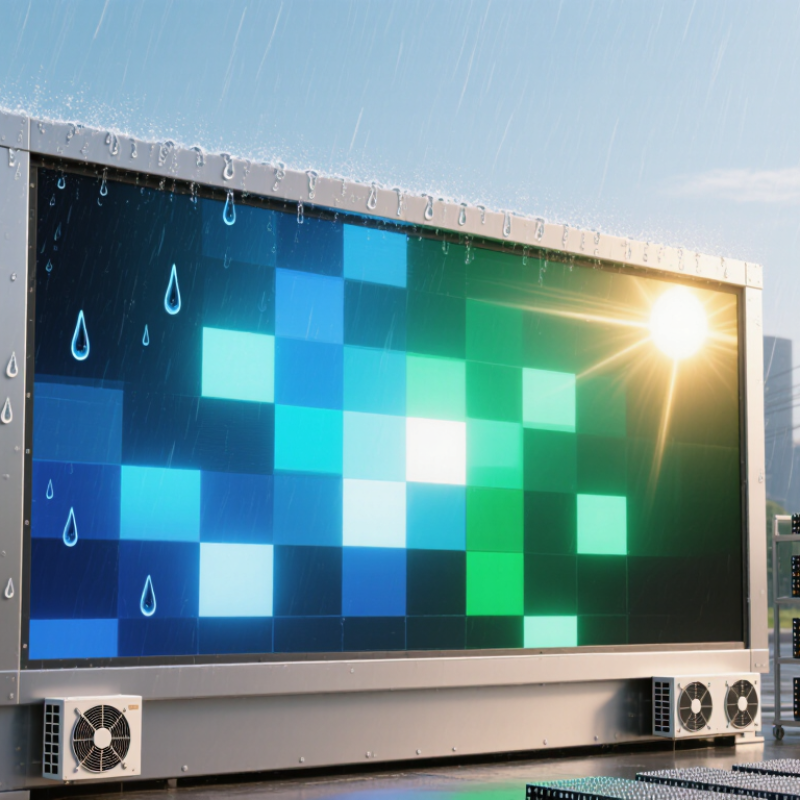
Field experience also reveals an uncomfortable detail: the cheapest quotation can become expensive after installation. Some specifications look impressive but omit cabinet weight, peak power, or service access. I would compare total ownership cost, not only purchase price. Ask the manufacturer to demonstrate a complete cabinet under heat, rain, and direct sunlight. That practical test may expose weaknesses earlier than a polished brochure.
How to Choose an Outdoor LED Display Manufacturer? - What an Outdoor LED Display Manufacturer Provides
| Selection Dimension | What to Check | Typical Technical Reference | What a Qualified Manufacturer Provides |
|---|---|---|---|
| Application and Viewing Distance | Confirm whether the display is for a roadside sign, stadium, retail facade, public square, transportation area, or event production. | The suitable pixel pitch depends on the closest viewing distance, content detail, screen size, and budget. A smaller pitch generally supports closer viewing. | Provides application analysis, recommended pixel-pitch options, viewing-distance guidance, and a display layout based on the installation environment. |
| Pixel Pitch and Resolution | Compare pixel pitch, cabinet resolution, total screen resolution, image detail, and content type. | Common outdoor products use pixel pitches such as 4 mm, 5 mm, 6 mm, 8 mm, or 10 mm. The final resolution is determined by screen dimensions and pixel pitch. | Provides product specifications, pixel-pitch samples, resolution calculations, cabinet drawings, and content-preview recommendations. |
| Brightness and Daylight Visibility | Verify measured brightness, automatic brightness control, readability in direct sunlight, and nighttime dimming performance. | Outdoor LED displays commonly require high brightness, often around 5,000–10,000 nits depending on sunlight exposure and local regulations. Actual performance should be confirmed by test data. | Provides brightness test results, light sensors, automatic brightness adjustment, calibration, and recommended settings for daytime and nighttime operation. |
| Weather Protection | Check the enclosure's ingress protection rating for rain, dust, and water exposure, along with drainage and sealing design. | Outdoor modules and cabinets are often specified with IP65 or higher protection on the front. The exact rating must be confirmed for the complete assembled product. | Provides sealed cabinets, waterproof connectors, drainage details, environmental test documentation, and installation guidance for exposed locations. |
| Operating Temperature and Ventilation | Review the rated operating temperature, heat dissipation method, cooling fan arrangement, and performance in hot or cold climates. | The operating range varies by product. Outdoor systems should be selected according to the site's minimum and maximum temperatures, solar exposure, and airflow conditions. | Provides thermal design information, temperature ratings, fan or fanless cooling options, environmental test reports, and maintenance instructions. |
| Refresh Rate and Image Quality | Consider refresh rate, grayscale performance, color uniformity, viewing angle, scan mode, and camera compatibility. | A refresh rate of 3,840 Hz or higher is commonly selected for content that may be recorded by cameras. Required performance depends on the application and camera system. | Provides receiving cards, control systems, calibration files, color-management support, and testing with photographs or video cameras when required. |
| Energy Consumption | Compare maximum and average power consumption, power supply efficiency, operating schedule, and local electricity capacity. | Actual power consumption depends on pixel pitch, brightness, content, refresh settings, and cabinet design. Maximum and typical values should be listed separately. | Provides power calculations, electrical load schedules, power distribution plans, energy-saving settings, and recommendations for circuit protection. |
| Cabinet Structure and Installation | Evaluate cabinet size, weight, material, front or rear maintenance, mounting method, wind load, and access for service. | Installation requirements vary according to screen area, building structure, local wind conditions, elevation, and whether the display is freestanding or wall-mounted. | Provides cabinet drawings, structural interface information, mounting hardware options, maintenance access plans, and coordination documents for installers. |
| Safety and Electrical Compliance | Request documentation for electrical safety, electromagnetic compatibility, grounding, surge protection, and applicable local requirements. | Relevant requirements may include product safety, EMC, low-voltage, grounding, and regional certification obligations. Required documents differ by market. | Provides compliance documents, wiring diagrams, grounding instructions, surge-protection recommendations, and technical support for local approval processes. |
| Control System and Connectivity | Check content scheduling, remote monitoring, network options, playback formats, redundancy, and compatibility with existing systems. | Control solutions may support Ethernet, fiber, Wi-Fi, 4G/5G, or other network methods depending on the project and site connectivity. | Provides sending and receiving equipment, playback software, remote-control functions, user training, system configuration, and troubleshooting support. |
| Reliability and Quality Control | Ask about component screening, production inspection, aging tests, module consistency, spare parts, and failure-rate tracking. | A complete quality program should include incoming material inspection, assembly checks, burn-in or aging tests, calibration, and final functional testing. | Provides inspection records, test procedures, production photographs or videos when agreed, serial-number tracking, and a documented quality-control process. |
| Warranty and After-Sales Service | Review warranty duration, covered parts, response time, exclusions, replacement procedures, and remote or on-site service availability. | Commercial LED display warranties commonly cover manufacturing defects for a defined period, often one to three years, subject to contract terms and operating conditions. | Provides a written warranty, troubleshooting procedures, spare-parts recommendations, technical support channels, and service escalation contacts. |
| Maintenance and Spare Parts | Consider module replacement time, power supply access, common spare-part compatibility, tool requirements, and maintenance training. | Front-serviceable cabinets can simplify maintenance where rear access is limited. Spare quantities should reflect screen size, operating hours, and project criticality. | Provides spare modules, power supplies, receiving cards, masks, cables, maintenance tools, replacement instructions, and operator training. |
| Total Cost of Ownership | Compare purchase price with installation, transport, electricity, maintenance, spare parts, software, structural work, and future replacement costs. | A lower initial price may result in higher long-term costs if the display has greater energy use, difficult maintenance, limited spare parts, or inadequate weather protection. | Provides a detailed quotation, bill of materials, installation assumptions, operating-cost estimates, recommended spare inventory, and optional service packages. |
| Project Documentation and Delivery | Confirm production schedule, packaging, shipping terms, installation drawings, user manuals, test reports, and acceptance criteria. | The delivery package should match the approved specification and include documents needed for installation, commissioning, operation, and future maintenance. | Provides technical drawings, packing lists, factory test records, installation manuals, commissioning support, training materials, and final project documentation. |